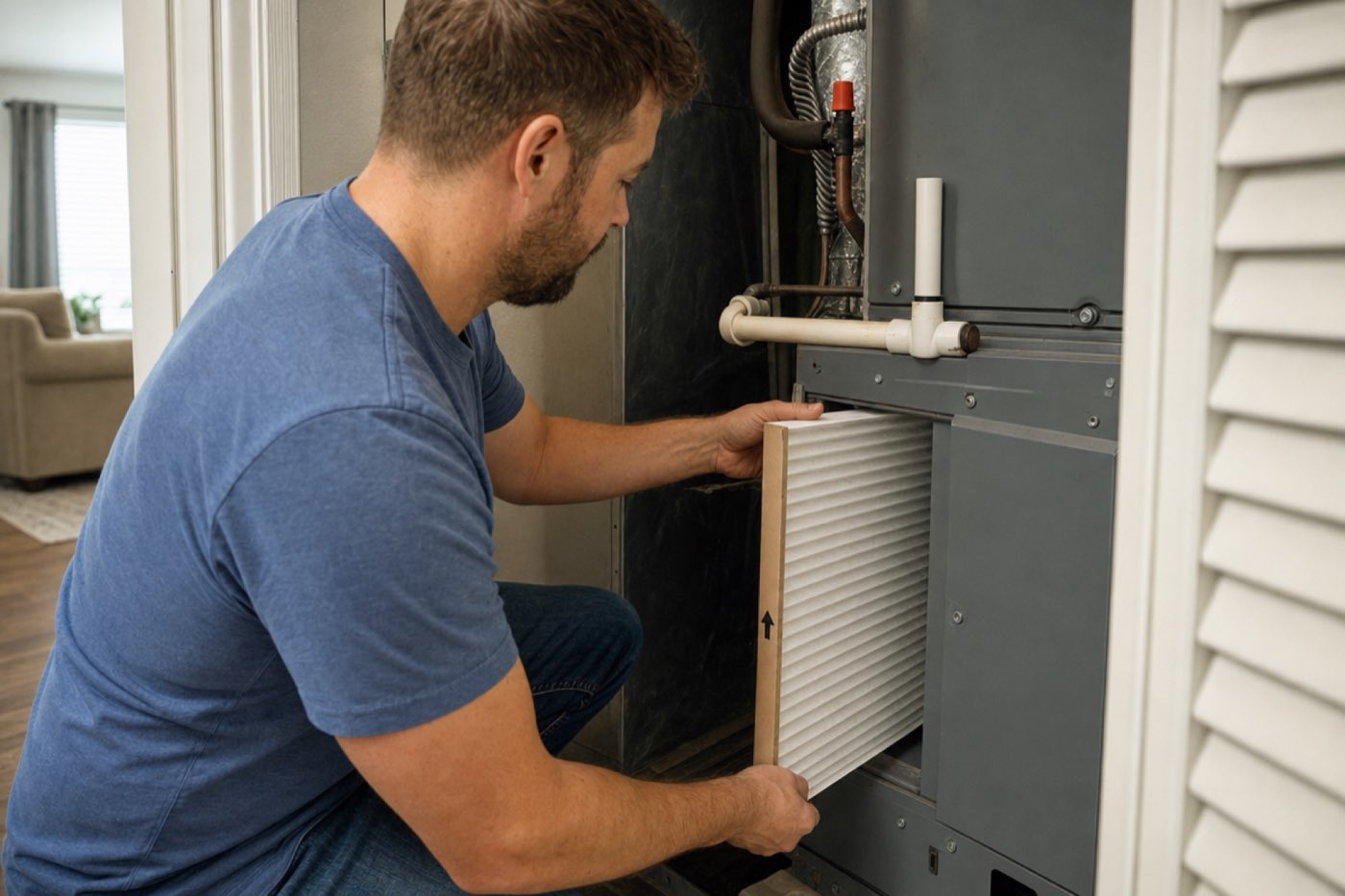
The airflow arrow on a furnace filter always points toward the furnace blower motor and away from the return air duct, the same direction the air travels. Check it in mid-October, before Fort Worth's first fall heating days, because a backward filter restricts airflow and can lock the furnace out when a November cold front arrives.
Which way should the arrow point, and how do you check?
The arrow points into the furnace, toward the blower. Air moves from the return duct, through the filter, and then to the blower, so the arrow follows that path.
- Turn the thermostat to off before you open the filter slot.
- Slide out the old filter and find the arrow printed on its cardboard frame.
- Note which side faces the return duct and which faces the blower.
- Insert the new filter so the arrow points toward the blower and away from the return duct.
- Write the install date on the frame so you know when it is due.
If the old filter was in backward, the arrow on it will point toward the return duct. That tells you the furnace may have been running with a restricted filter.
Why does a furnace filter have a front and a back?
Filters are built stronger on one side. Many use wire mesh on the side that faces the blower so the media can withstand the suction that pulls air through it.
Filter construction varies. Some filters use a wire support and others use a different reinforcement method, but the arrow tells you which side is built to face the blower.
What happens if you install a furnace filter backward?
With the support on the wrong side, blower suction can pull the filter media away from its reinforcement and collapse it. A collapsed or distorted filter blocks air that should be passing through the furnace.
Here is how a backward filter can lead to a shutdown:
- The media collapses or bunches. Less air gets through.
- Airflow drops. The Department of Energy's Building America program notes that a dirty or restrictive filter can reduce airflow below the desired rate and degrade system efficiency.
- The heat exchanger runs hot. Less air passing over it means the heat has nowhere to go.
- The high-limit switch trips. This safety switch shuts the burners off to protect the furnace.
The furnace may then cycle on and off or stay off until it cools and resets.
Why does this matter during a Fort Worth cold front?
Your furnace sits idle through the long Texas cooling season, and the first hard run often comes with a sudden November cold front. If the filter is backward or clogged at that moment, the furnace is working against restricted airflow.
On a gas furnace, restricted airflow means you burn fuel less efficiently, and a high-limit trip can leave you without heat on the coldest night of the week. Checking the filter in October takes a few minutes and avoids both problems.
If the furnace still shuts down after you fix the filter, schedule a furnace repair visit so a licensed technician can check the safety controls.
How much airflow resistance is too much?
The Department of Energy says most residential HVAC systems operate efficiently when total system pressure drop is no higher than approximately 0.4 to 0.5 inches of water column. Every part of the duct system uses some of that budget, and the filter is one of them.
A standard clean furnace filter has approximately 0.10 inches of water column pressure drop under ACCA guidance. That is roughly a fifth to a quarter of the whole budget before any dirt collects.
Dirt raises the filter's pressure drop, and higher-MERV filters can clog faster because they trap more particles. A backward, collapsed filter pushes resistance up even faster.
Which filter size and MERV rating protect your airflow?
The filter you choose changes how hard your blower works. The Department of Energy gives these guidelines:
| Choice | Effect on airflow |
|---|---|
| Higher MERV rating | Imposes substantially more resistance than a lower rating |
| MERV 8 | Can reduce airflow in systems with PSC motors and increase fan power in systems with ECM motors |
| MERV 16 | Suited only to low-leakage duct systems, since it can push the blower toward its limit and add noise |
| Four-inch filter | Generally performs better than one- or two-inch filters at reducing airflow resistance |
| Larger area or deeper pleats | Reduces pressure drop |
The practical rule is to match the filter to your equipment. If you want finer filtration, a deeper or larger filter is the way to get it without choking the blower. A technician can tell you which motor type you have during a seasonal maintenance visit.
What should you do before the first cold front?
- Check the arrow direction on the filter now, in October.
- Replace the filter if it has been in place a while or you are unsure of its age.
- Do not jump to a high MERV rating without knowing what your blower can handle.
- Keep a spare filter of the right size on hand so you can swap it quickly.
If you need a technician, our guide to how to choose a licensed HVAC company explains what to ask before you book.
Not sure whether your furnace is ready for winter? Call (817) 420-7026 or send a service request and we will connect you with a licensed local heating and air company. Air Conditioning Repair Fort Worth is a free referral service, not a contractor.